
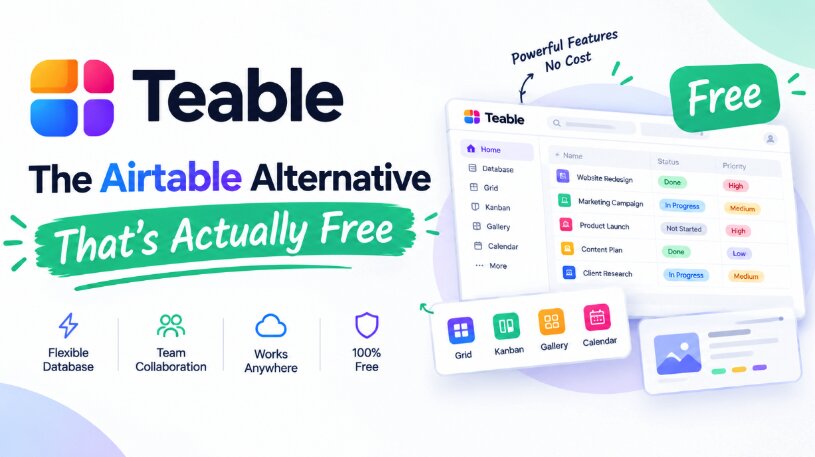
Teable - Open Source Airtable Alternative That's Actually Free
Airtable costs $20 per user per month and stores your data in a proprietary system you cannot query. Teable is open source, built on PostgreSQL, self-hostable with unlimited rows for free, and just launched AI agent access in version 3.0.
By w3codemasters
Airtable's Team plan costs $20 per user per month. Give twenty people access and that is $4,800 per year before automation costs. The October 2025 policy change made the pricing worse. The underlying data lives in a proprietary store you cannot query directly, cannot self-host, and cannot take with you without going through their export tools.
This is the trade-off Airtable asks you to accept: a genuinely good product, at a price that scales against you, on infrastructure you do not control.
Teable is built as the answer to that specific problem.
What Teable Is
Teable is an open-source, AI-native, no-code database platform built on PostgreSQL. It gives you Airtable's spreadsheet interface — grid, kanban, gallery, calendar, and form views — sitting on top of a real SQL database that you own, can query directly, and can self-host on your own infrastructure.
As described by tooldirectory.ai, Teable is an Airtable-style spreadsheet-database hybrid with a PostgreSQL backend, so data stays in a real SQL database you can query and self-host. It layers AI on top — AI chat, AI fields, natural-language automations, and an app builder — to build CRMs, internal tools, and workflows without code.
The project has over 21,000 GitHub stars and holds ISO 27001 and ISO 9001 certifications. Version 3.0 launched in early September 2026.
The Architecture Difference That Actually Matters
The most important distinction between Teable and Airtable is not the price. It is where the data lives and what you can do with it.
Airtable stores your data in a proprietary system. You cannot run SQL queries against it directly. You cannot connect BI tools to it without going through their API. If you want to leave, you export and migrate. The storage is Airtable's, not yours.
Teable stores your data in standard PostgreSQL tables. As explained by repocloud.io, records live in standard SQL tables, so BI tools, analytics pipelines, and your own applications can JOIN and query them directly — no exports, API rate limits, or sync jobs. If you self-host and decide to stop using Teable, the PostgreSQL database itself is the export.
For teams that need to connect their database to reporting tools, run custom queries, or maintain data sovereignty for compliance reasons, this architectural difference is more significant than any feature comparison.
Pricing — Where Teable Actually Wins
Airtable's Team plan starts at $20 per user per month. Its free tier caps records at 1,000 rows per base.
Teable's pricing, as confirmed by scribehow.com:
The cloud free plan includes 1,000 rows, 1 GB storage, 500 AI credits, and all five view types. Pro starts at $10 per seat per month — half of Airtable's equivalent tier. Business starts at $20 per seat per month and includes 2,000 AI credits per seat.
The self-hosted community edition is free with unlimited rows and unlimited storage. No per-seat charge beyond infrastructure cost.
As noted by cloudzy.com, the self-hosted edition removes row and storage scaling entirely — unlimited rows, unlimited attachments, and no per-seat charge beyond infrastructure. For teams with more than ten users who have the technical capacity to run a Docker deployment, the cost comparison against Airtable is significant.
What Teable 3.0 Added — AI Agent Access
Version 3.0, released in early September 2026, added a feature that separates Teable from every other Airtable alternative in the open-source category: the Teable Skill.
As detailed by datastudios.org, external AI agents — including Claude Code and ChatGPT — can now connect directly to a Teable Base and manage its tables, fields, views, records, automations, and apps, rather than going through a generic Web API a developer has to wire up manually.
In practice this means a developer working in Claude Code can ask it to restructure a table, add an automation, or generate a new view without leaving their coding environment — because the agent has direct access to the database structure rather than having to interact through a standard API.
This is not a feature Airtable offers. It is also not available in NocoDB or Baserow, the two most established open-source Airtable alternatives. For teams that are building AI-powered workflows — CRM enrichment, batch content generation, or conversational database building — it changes what is possible without custom development.
The AI Features Inside Teable
Beyond external agent access, Teable has built AI functionality into the product itself.
AI fields generate content automatically based on other fields in a record — write a product description based on name and category, summarize a support ticket, classify records by type. Natural-language automations let you describe what you want to trigger in plain language rather than building automation logic manually. An AI chat interface lets you query and manage your database through conversation.
As noted by scribehow.com, Teable is the better choice when AI-powered workflows are central to operations — CRM enrichment, batch content generation, or conversational database building.
How Teable Compares to Other Open-Source Alternatives
Three tools dominate the self-hosted Airtable alternative category: NocoDB, Baserow, and Teable.
As summarized by cloudzy.com, the recommendation varies by use case. NocoDB is the choice when data already lives in an existing MySQL, PostgreSQL, or other SQL database — it points at your existing database instead of requiring migration. Baserow is the choice for teams that need safer shared editing and a more stable product with fewer sharp edges. Teable is the choice for teams that want free self-hosted AI features and a cleaner Docker deployment than NocoDB typically requires.
The licensing distinction matters too. NocoDB moved to a Sustainable Use License in January 2026, which permits internal use but restricts resale. Teable runs under AGPL-3.0 — a stronger guarantee for teams that need to modify or embed the code. As noted by datastudios.org, the AGPL-3.0 license means the code can be run, modified, and even embedded in a product a team sells — a structural difference from NocoDB's current licensing position.
The Airtable Acquisition Context
In August 2026, Airtable was acquired by Bending Spoons in a $1.285 billion all-cash deal.
As noted by zite.com, Bending Spoons is a private equity firm that buys established software and runs it for profit, which often means higher prices and slower product updates. Users who have been on the fence about Airtable now have an additional reason to evaluate alternatives before pricing or product decisions change.
The timing of that acquisition, combined with Teable's 3.0 release and its growing GitHub star count, puts the product in a useful position for teams actively evaluating their database tooling.
Who Should Use Teable
Teams with technical capacity to run a Docker deployment who want unlimited rows and zero per-seat cost should evaluate the self-hosted edition first. The setup is straightforward relative to other self-hosted database tools and the ongoing cost is infrastructure only.
Teams on the cloud version who need AI-powered fields and natural-language automations alongside a standard Airtable-style interface have a meaningfully cheaper option than Airtable at the Pro tier.
Developer teams building internal tools who want AI agents to interact directly with their database structure — rather than through a generic API — have a specific reason to evaluate Teable 3.0 that does not exist in any other Airtable alternative currently available.
The gap Teable does not fully close is Airtable's integration library and polish. As noted by scribehow.com, the native integration library is smaller than Airtable's. The API and webhook support cover most use cases, but teams that rely on specific Airtable-native integrations should verify coverage before migrating.
According to Wikipedia on open-source software, the defining characteristic of open-source tools is that source code is made available for modification and distribution — which is precisely what gives Teable's self-hosted users the data sovereignty that Airtable's architecture cannot offer regardless of pricing.
The Honest Summary
Teable is not the right choice for every team. For teams that want a polished, fully managed product with an extensive integration library and no interest in self-hosting, Airtable remains the standard.
For teams that need data sovereignty, unlimited rows without scaling costs, AI-native features at half the cloud price, and the ability to give AI agents direct database access — Teable in its current form is the most capable option in the open-source Airtable alternative category.
The self-hosted edition being free with unlimited rows is not a trial limitation or a stripped-down version. It is the product, running on your infrastructure, with your data in a PostgreSQL database you fully control.
That is what makes it different from every other "free" Airtable alternative that caps rows, adds a watermark, or restricts features to push you toward a paid plan.
