
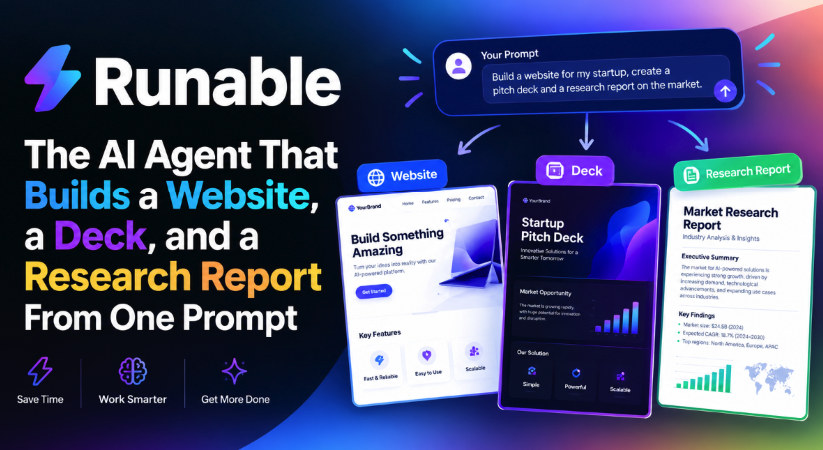
Runable — The AI Agent That Builds a Website, a Deck, and a Research Report From One Prompt
Runable is not a chatbot. It is an AI agent that takes a plain-English instruction, plans the steps, executes them, and hands you a finished website, deck, or research report. Indian-founded startup, $21M Series A, $2M ARR in three weeks.
By w3codemasters
Most AI tools give you words. Runable gives you deliverables.
That is the single clearest way to explain what makes it different from ChatGPT, Claude, or Gemini. When you ask ChatGPT to build a landing page, it gives you HTML to copy. When you ask Runable to build a landing page, it plans the steps, writes the code, deploys the site, and hands you a live URL.
The distinction between a chatbot that generates text and an agent that completes tasks is the core of what Runable is built around. And the numbers behind its early growth suggest it has found real demand for that distinction.
What Runable Is
Runable is a general-purpose AI agent platform founded in 2025. It takes a plain-English instruction and completes the whole task end to end — planning the steps, browsing the web when it needs to, writing and running code, generating media, and delivering a finished file or a live link.
As described in Runable's own documentation, the mental model that helps most is to think of it less like a chatbot and more like a fast contractor with a browser, a code editor, a design tool, and a video suite already open.
The range of tasks it can complete from a single prompt includes fully deployed websites and landing pages, presentation decks with structure, copy, and visuals already in place, research reports with citations pulled from live sources, short videos, voiceovers, and cleaned spreadsheets.
The Indian-founded startup raised a $21 million Series A in August 2026, as reported by TechCrunch. The round was co-led by Susquehanna Venture Capital and Nexus Venture Partners, with Together Fund and Array VC also participating. The funding valued Runable at $65 million post-investment. Co-founder and CEO Umesh Kumar said the company went from zero to $2 million in annualized revenue within three weeks of launching payments in March 2026.
Runable 2.0 — What Changed
Version 2.0, launched in March 2026, addressed the most significant failure mode of the original product.
As described on the Runable blog, the problem was not what the agent could do — it was that it started doing things before it fully understood what was needed. You type a prompt. The AI builds something. You wait. What comes back is close but not right. You tweak and try again.
Version 2.0 introduced a plan-first workflow — the agent shows its intended approach and waits for confirmation before executing. This single change removed most of the iteration cycle that frustrated early users.
Other additions in 2.0 include inline AI editing inside the output, one-click rollback to any previous version, chat forking to test multiple directions from the same starting point, and Canvas Mode for image and video work.
The Four Things It Does Best
Websites and Landing Pages
Runable builds and deploys full-stack websites from a single prompt. The output is a live URL, not a code file you need to host yourself. For small businesses, freelancers, and founders who need a web presence without a developer, this is the most immediately practical capability.
Research and Competitive Briefs
The agent browses the live web, pulls sources, and assembles structured research reports rather than generating summaries from training data alone. For analysts, consultants, and content teams that regularly produce research-heavy documents, the time reduction versus manual research is significant.
Presentations
Runable builds slide decks with structure, copy, and visuals already in place — not a blank template with placeholder text. For professionals who produce decks regularly and spend more time on formatting than thinking, this addresses the most time-consuming part of the process.
Videos and Media
Canvas Mode handles image and video generation inside the same workflow as text and web tasks. The output quality is what you would expect from current AI video generation — good for social content and explainers, not for broadcast production.
Pricing
As of July 2026, Runable has three tiers. Free includes 1,500 daily credits refreshed every day with no card required. Pro costs $20 per month and covers most professional use cases. Max costs $100 per month for higher-volume usage.
The credit model means that heavy media tasks — 4K video, long audio, AI-generated soundtracks — consume credits faster than text and web tasks. Unused credits do not roll over. As noted in Runable's own usage guide, the transition point where a paid plan becomes worthwhile is when you are running multiple agent tasks per day and hitting the free tier's daily refresh limit.
The pricing competes directly with ChatGPT Plus at $20 per month — the same price for a different category of tool. One generates text you then act on; the other completes the action.
The Growth Strategy Beyond Building
The $21 million Series A was raised specifically to expand what Runable does after a business is built.
As reported by TechCrunch, Runable is extending its agent into what it calls the "grow" side — running ad campaigns, managing social media, handling SEO, and optimizing a business's presence in AI chatbot results. The vision is a single platform that handles building a business's digital presence and then growing it, rather than stopping at the built product.
This positions Runable in a market that includes AI builders like Lovable and Replit on the build side, and marketing automation tools on the growth side — with Runable attempting to span both in one agent.
What the Critical Reviews Say
Not all coverage of Runable has been positive. A detailed review published by future-stack-reviews.com identified a significant gap between the marketing and the product: the platform's claimed 3,000-plus app integrations were found to be Zapier-mediated connections rather than native integrations — a material difference if you are relying on direct connectivity rather than a middleware layer.
The same review flagged data governance concerns for teams and EU buyers, and noted that pricing information across Runable's own pages was inconsistent at the time of testing.
These are not dealbreaker concerns for a solo creator or small business using the platform for website building and content production. They are relevant concerns for a team deployment or an EU-based business with data residency requirements.
According to Wikipedia on AI agents, an intelligent agent perceives its environment and takes actions to achieve defined goals — which is the technical definition Runable's product is built around. The gap between that definition and any specific implementation is always where the honest evaluation of an AI agent lives.
Who Should Use It
Runable is best suited for solo creators, small business owners, and individual professionals who regularly produce websites, decks, research documents, and content — and who currently use four or five separate tools to complete one end-to-end task.
The free tier with 1,500 daily credits is genuinely enough to evaluate whether the agent produces output that meets your quality bar before committing to a paid plan. The specific tasks worth testing first are the ones where your current process involves the most tool-switching — that is where the reduction in friction is most immediately obvious.
For teams, the governance considerations flagged in critical reviews — data handling, integration authenticity, shared-channel behavior — need answers before deployment at scale.
For EU-based users, data residency and GDPR compliance questions should be confirmed directly with Runable before using the platform for work involving personal or client data.
The Context in 2026
Runable is entering a market that is moving fast in the same direction it is. As noted by aigovernancecourses.com, the AI agent platform category now includes Manus, Lovable, Replit, Cursor, and the consumer-facing agents from Anthropic and OpenAI directly.
The differentiation Runable is betting on is breadth plus deployment in one place — not just generating content but publishing it, not just writing code but hosting it. Whether that combination proves more durable than the specialized tools that do one thing extremely well is the question the next twelve months of product and revenue data will answer.
The $21 million Series A and the $2 million ARR milestone within three weeks of launch are the most concrete signals available that the market has confirmed some version of that bet. The rest is a product question.
