
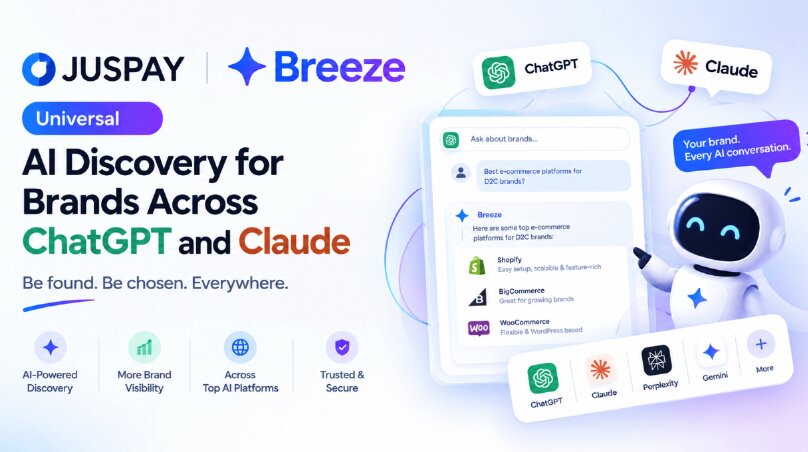
Juspay Breeze Universal — How Brands Now Appear Inside ChatGPT and Claude Shopping
Consumers are asking ChatGPT and Claude for product recommendations instead of searching Google. Juspay's Breeze Universal, launched September 2, 2026, lets brands appear in those AI conversations without rebuilding their commerce infrastructure.
By w3codemasters
For the last decade, brand discovery meant search engine optimization. You optimized your product pages for Google, paid for shopping ads, built a presence on marketplaces, and hoped customers found you before they found your competitor.
That model is being disrupted faster than most brands have noticed.
A growing share of product discovery is moving into AI chat interfaces. Instead of opening a browser and typing a search query, consumers are asking ChatGPT "what's the best skincare product under ₹1,500" or asking Claude "gift ideas for someone who travels a lot." The AI recommends. The consumer buys — or they used to have to leave the chat window to do so.
Juspay, a Bengaluru-based global payments technology company, launched Breeze Universal on September 2, 2026, to address exactly this shift. It is a platform that makes a brand's product catalogue discoverable across AI platforms — ChatGPT, Claude, and others — without requiring the brand to rebuild its commerce infrastructure from scratch.
What Breeze Universal Does
Breeze Universal sits between a brand's existing product catalogue and the AI platforms where consumers increasingly search for products.
As described in the Finextra launch coverage, it connects to a business's existing stores and catalogues across Shopify, WooCommerce, Magento, and custom storefronts. Once connected, that catalogue becomes available across the surfaces where customers shop — AI platforms, mobile apps, websites, and banks' own digital interfaces — without the brand having to integrate separately with each one.
The consumer-facing experience, as reported by Business Standard, works like this: a shopper types @breeze inside ChatGPT, asks a natural language question — "gift ideas for someone who's always on trend" or "skincare products under ₹1,500" — and receives recommendations from multiple participating brands. They can discover, compare, and filter results without leaving the AI chat window.
For brands, the proposition is straightforward: make an existing catalogue available wherever consumers are increasingly looking, without rebuilding commerce infrastructure or managing separate integrations for each AI platform.
The Three Ways Brands Can Participate
Breeze Universal offers three deployment options depending on what a brand needs.
The first is a branded app inside ChatGPT — published by Breeze, carrying the brand's identity — that gives the brand its own presence inside the ChatGPT interface. A consumer can interact with @yourbrand directly inside the chat window.
The second is an AI-powered storefront — a brand's own discovery interface with a single search bar across the full catalogue, powered by the same underlying LLM infrastructure.
The third is drop-in components, a headless kit, or APIs for brands that want to integrate Breeze Universal into their existing technical setup rather than using Juspay's pre-built interfaces.
Built on Google's Universal Commerce Protocol
The underlying technical foundation matters for understanding why Breeze Universal is positioned as a long-term infrastructure play rather than a short-term integration.
Breeze Universal is built on Google's Universal Commerce Protocol — a cross-platform standard for AI commerce that Google designed to work across Search, Gemini, and third-party AI surfaces. As noted by Finextra, building on UCP means brands that join Breeze Universal become compliant with AI commerce standards from day one, without needing separate integration work as the protocol becomes more widely adopted.
The broader context for this, as covered by tech-insider.org, is that four major platforms — OpenAI, Microsoft, Google, and Anthropic — are each running different strategies for agentic commerce in late 2026. Anthropic launched Claude Commerce Agents on September 2, 2026 — the same day as Breeze Universal's launch — explicitly targeting the holiday shopping season. Google is betting on UCP as a portable standard. Microsoft is testing Copilot Checkout with retailers.
Juspay's positioning within this is to be the infrastructure layer that connects brands to all of these surfaces simultaneously, rather than requiring brands to integrate with each AI platform independently.
Why This Matters More Than It Might Appear
According to Wikipedia on AI assistants, the number of people using AI chat interfaces for information and recommendations has grown dramatically since the launch of large language models in 2022. The shift from search-engine discovery to AI-conversation discovery is not a hypothetical future trend — it is already changing how a measurable share of consumers find products.
The practical implication for brands is that product catalogue visibility inside AI platforms is becoming a new category of marketing infrastructure alongside SEO, paid search, and marketplace listings.
Most brands have not yet built that infrastructure because the platforms are new, the standards are still forming, and the technical overhead of integrating separately with each AI platform has been prohibitive for any team without dedicated engineering resources.
Breeze Universal's value proposition is removing that overhead. Rather than building separate integrations with ChatGPT, Claude, Gemini, and any AI platform that emerges next, a brand connects once to Breeze Universal and the distribution happens across platforms through the shared infrastructure.
Who It Is Built For
Breeze Universal is described by Juspay as suitable for banks, fintechs, marketplaces, and brands — any organization with an existing seller audience that wants to offer AI-powered shopping experiences without building complex infrastructure.
The specific use cases that emerge from the launch coverage point to three distinct types of buyers.
For direct-to-consumer brands already on Shopify or WooCommerce, the connection is straightforward and the catalogue integration requires no platform migration. The brand joins, the catalogue becomes available, and product discovery in AI chat interfaces becomes a new channel alongside existing ones.
For banks and fintechs with a consumer base that shops through the institution's app or portal, Breeze Universal enables them to deploy an AI-powered shopping experience — their users discover and buy products from participating brands without leaving the bank's interface. The bank becomes a commerce surface without building ecommerce infrastructure.
For marketplaces with an existing merchant base, Breeze Universal provides a path to make that merchant inventory discoverable through AI interfaces without requiring each merchant to integrate individually.
The Juspay Context
Juspay is primarily known as a payments infrastructure company. Its Breeze platform originally focused on checkout and payment enablement — making the transaction step of ecommerce faster and more reliable.
Breeze Universal marks an explicit expansion of that strategy into an earlier stage of the commerce funnel — discovery. As Sheetal Lalwani, COO and co-founder of Juspay, described in the launch announcement: "Through Breeze Universal, Juspay aims to be the technology service provider that enables brands to become discoverable within AI-led conversations and seamlessly connect discovery with commerce."
The move from checkout to discovery gives Juspay a position across the full commerce journey — from the moment a consumer decides what to look for, through discovery, comparison, and purchase — rather than only at the payment step.
The Honest Assessment
Breeze Universal is in global pilot — meaning it is not yet at full commercial scale and the participating brand count, actual consumer usage data, and conversion performance are not publicly available.
The concept is well-timed. AI commerce is an active battleground right now, the major AI platforms are building commerce capabilities simultaneously, and the need for a shared infrastructure layer that connects brands to all of them is real. Juspay's payments background gives it credibility in the commerce space that a pure-play AI startup entering this category would not have.
The questions that pilot data over the next few months will need to answer: how much of the consumer shopping journey has actually shifted into AI chat interfaces versus how much remains in search and direct browsing, what conversion rates look like for AI-discovered products versus search-discovered products, and whether the @breeze ChatGPT integration drives enough consumer adoption to make the brand-side investment worthwhile.
For brands evaluating where to build discovery infrastructure in Q4 2026, Breeze Universal is the most structured answer currently available to the question of how to appear inside AI conversations without managing the integrations individually.
