
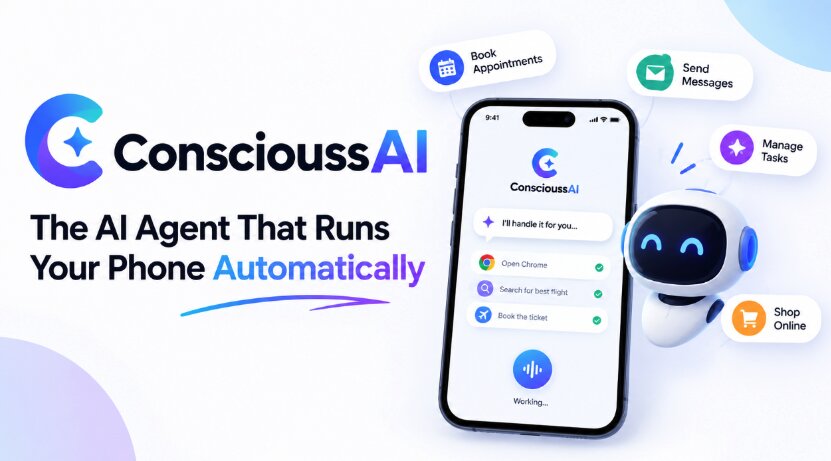
ConscioussAI — The AI Agent That Runs Your Phone and Computer Automatically
ConscioussAI integrates with your operating system and runs your devices the way you would — scheduling workflows, responding to context, and acting through regular text messages. This is what consumer agentic AI looks like in practice.
By w3codemasters
Most AI tools wait for you to open them.
You open the app, type a prompt, read the response, and then go do the thing yourself. That is still a chat interface with extra steps. It is not an agent — it is a fast search engine that writes in sentences.
ConscioussAI is built on a different premise. Instead of waiting for you to ask a question, it integrates directly with your operating system and runs your device the way you would — navigating apps, using the browser, understanding what is on your screen, and completing tasks without you managing each step.
It is not another chatbot. As the team describes it directly, ConscioussAI is the execution layer for your devices — built to turn intent into action.
What ConscioussAI Actually Does
The gap between AI assistants and AI agents is the gap between telling someone how to do something and hiring someone to do it. ConscioussAI sits on the agent side of that line.
On desktop, it works where serious work happens — files, dashboards, documents, browser tabs, apps, code, email, reports, and recurring workflows. It can understand screen context, navigate apps, use a browser, run workflows, and take over tasks with permission.
On mobile, it handles the workflows that happen on a phone — making plans, communicating, buying things, managing the day. Book the reservation. Add the grocery list to the cart. Prepare the ride. Follow up on the task. Help choose the photos.
The vision behind the product is straightforward: instead of asking an assistant how to do something, users should be able to ask for the result.
The Four Features That Define It
SOL — Text Message Control
SOL is the texting layer of ConscioussAI. It lets users control the agent through regular text messages rather than opening another app or starting a new chat every session.
This matters more than it might seem. Every other AI agent requires you to be at your computer, inside a specific interface, actively managing the conversation. SOL removes that constraint. You text the same way you text a person, and ConscioussAI acts on your device as a result.
The design reflects a specific belief: AI agents should be accessible to people who do not want to learn a new system. Regular text messages are the most universal interface that exists.
Ambient Mode — Proactive Assistance
Most AI tools are reactive. You prompt, they respond. Ambient Mode shifts that dynamic — ConscioussAI monitors context passively and surfaces relevant help when it notices something worth acting on.
The example the team gives is direct: ConscioussAI can notice dinner plans inside a conversation, ask if you want help, then make the reservation and send calendar invites if approved. The trigger is context, not a prompt. The action is complete before you would have thought to start it.
Scheduled Workflows — Work That Runs Before You Open Your Computer
ConscioussAI can run recurring workflows on a schedule, even when you are not actively using your device. If certain tasks need to be completed every day before a specific time, ConscioussAI runs them in the background and has the deliverables ready when you sit down.
For anyone who spends the first thirty minutes of every workday doing the same sequence of tasks — checking dashboards, compiling reports, pulling data, sending status updates — scheduled workflows replace that routine entirely.
Screen Share — Remote Assistance Without Screenshots
Instead of pasting screenshots into a chat and explaining what you are looking at, Screen Share lets ConscioussAI see your actual screen and help directly from what it observes. The friction of translating a visual problem into text disappears — you show, it understands, it acts.
Why This Matters Now
According to research from symphony-solutions.com, over 57 percent of enterprises are already running AI agents in production in 2026, with Gartner predicting 40 percent of enterprise applications will include task-specific agents by the end of the year — up from less than 5 percent in 2025.
The shift from conversational AI to operational AI is the defining transition of 2026. As noted by prosus.com, the industry has moved from asking which is the smartest model to asking how long an agent can work autonomously before it breaks. Endurance and reliability are now the measure — not raw intelligence.
ConscioussAI is positioned at the consumer and prosumer end of this shift — the version of agentic AI built for individuals and small teams rather than enterprise infrastructure. According to Wikipedia on AI agents, an intelligent agent perceives its environment and takes actions to achieve goals — which is precisely the capability ConscioussAI is bringing to everyday device use rather than enterprise systems.
The space is filling up. Cloudvyn.com notes that Anthropic has shipped native computer use on macOS, Meta, Google, and OpenAI are building their own versions, and open-source alternatives like OpenClaw reached viral adoption in 2026. ConscioussAI's differentiation is the mobile-plus-desktop combination and the SOL text message interface — features that the major lab products do not currently offer together.
What It Is Not
ConscioussAI does not replace human judgment. Every action it takes that matters requires permission — it is not an autonomous system that operates without oversight. The model is closer to a capable assistant that executes on approval than a fully autonomous agent that acts without asking.
It also does not solve the underlying reliability problem that every computer-use agent faces. Navigating apps, reading screen context, and completing multi-step workflows across different interfaces still breaks in unpredictable ways depending on what software version, screen layout, or edge case it encounters. The technology is genuinely useful and genuinely early.
Who Should Pay Attention
Three groups of people have the most to gain from what ConscioussAI is building.
People who do the same sequence of tasks every day and have wondered whether a computer could just do it for them — scheduled workflows are the most immediately practical feature for this group.
People who manage their life from their phone rather than a desktop — the mobile-first design and SOL text interface are built specifically for this workflow, which most AI agents ignore.
People who want to try agentic AI without building technical infrastructure — ConscioussAI is designed for users who do not want to become technical operators, and that accessibility is a genuine gap in the current agent landscape.
The Honest Assessment
ConscioussAI is one of the more coherent answers to the question of what consumer-facing agentic AI should look like. The SOL text interface solves a real friction problem. Ambient Mode is a meaningful departure from the prompt-response loop that defines most AI tools. Scheduled workflows deliver the kind of practical value that justifies adoption.
Whether the execution matches the vision depends on factors that a product description cannot settle — reliability across real-world device environments, accuracy of screen understanding across different apps, and how gracefully it handles the edge cases that always appear when software tries to operate software autonomously.
It is worth watching. For users comfortable with early-stage tools who want agentic AI without enterprise pricing or developer setup, it is worth trying.
