
The hybrid cloud is definitely the one you’ve heard and read on. Most organizations and businesses make use of this hybrid cloud technology. Many professionals in this field have told you the benefit of this technology. So, then what is the deal here? What the heck is going on? In this article, we will talk about what is hybrid cloud and the benefits of a unified hybrid cloud platform.
Let’s begin with some basic information to give an insight into how prevalent hybrid clouds have evolved. Since the most current State of the Cloud press release, 95% of businesses have implemented cloud technology in some form. The bulk of those companies (67%) have made the switch to hybrid. Hybrid clouds, according to Gartner, will soon outnumber private and public clouds.
The advantages are almost the same regardless of whose theory of hybrid cloud you adopt. When storage and computation workloads exceed the capability of an on-premises database server. Then the enterprises use the hybrid cloud to immediately extend potentials up or down to deal with surplus capacity. This even lets enterprises save money and energy by not having to buy, install, and manage additional servers that they may not require all of the time.
What is Hybrid Cloud?
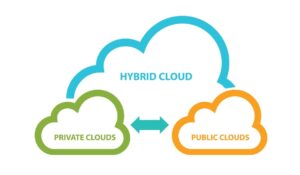
The term “hybrid cloud” refers to a system that integrates public and private clouds. The primary goal of combining public and private clouds is to establish a specific, efficient, and better cloud infrastructure. The public cloud has the responsibility to take care of non-critical activities, while the private cloud handles the vital tasks in the hybrid cloud. Bank, public health, and public universities are still the most typical sectors of the economy using hybrid clouds. Amazon, Microsoft, Google, Cisco, and NetApp are the finest hybrid cloud providers.
So, it is clear that a hybrid cloud is an infrastructure that conducts various applications across several workplaces. Because nearly no one nowadays highly depends only on the public cloud, hybrid cloud infrastructure options are becoming increassingly popular. Over the last few decades, many of you have made significant investments and vast amounts of on-premises services.
When distributed across public and private clouds, hybrid cloud servers comprise apps or their equipment such as computation, network security, and data transfer. For on-premises cloud applications, private clouds seem to be another term.
Hybrid Cloud Approach: Why is it essential?
One of the really frequent development options nowadays is a hybrid cloud strategy. Even though you may utilize your on-premises data centers yet simultaneously utilize public cloud services such as Google Cloud. If you would like to reap from the volume and privacy of a cloud provider, a hybrid cloud solution is right for you.
For example, Google Cloud can serve processing demands proximate to your clientele while protecting your data on-premises to cooperate fully with data residency regulatory frameworks. Hybrid internet of things (IoT) is a terrific solution for some of you who have crucial control systems in both cloud environments.
How does a hybrid cloud work?
Hybrid cloud architecture: Hybrid cloud architecture can take on many different forms. A hybrid cloud platform might include on-premises and public cloud technology. A public cloud and a private cloud might potentially be incorporated. It might also incorporate public and private clouds, as well as on-premises equipment. Irrespective of the configuration, hybrid cloud infrastructure will have some characteristics.
Data integration: A company’s public cloud and non-public cloud services are responsible to upgrade the collected piece of data. Functionality between these several platforms might be difficult. Furthermore, a company may want to install a computing resource solution that addresses data uniformly.
Network connections: Private clouds, enterprise resources, and public clouds are all closely intertwined, anything over the internet network. For a hybrid cloud infrastructure to succeed, an internet connection is essential.
Unified management: Hybrid cloud administration should ideally be done by a single solution, removing the need to mitigate individual servers individually. Operating clouds individually may be tough due to the fact that each company will have its own APIs, SLAs, and functionalities and services.
An API, or application programming interface, permits one program to “link” another platform’s function or capability. Or, in this example, an application server – and integrating that element or activity into the application’s own service.
A service-level agreement (SLA) is a contract that specifies the services that cloud service will offer.
Hybrid Cloud Connection
The communication links in between various infrastructures are critical in cloud infrastructure. An organization isn’t genuinely running a hybrid cloud if they aren’t linked. Meanwhile, they’re executing many clouds in unison, and documentation may not be consistent throughout them.
VPN: A VPN, or virtual private network, allows for safe, encoded Internet service. Someone or some computer connecting to a VPN may operate as discreetly as if they were linked to a private internal network because of the VPN protection. Clouds and on-premises equipment can join seamlessly over the public Internet with the use of a VPN.
WPN: In contradiction to a local area network (LAN), which links workstations remotely, a wide area network (WAN) provides connectivity across long distances. A WAN transmission is more trustworthy than a link to the open Network. A WAN should still use a VPN to establish a secure connection for hybrid clouds.
APIs: API integrations are critical for linking platforms, records, apps, and other resources in a hybrid cloud. When you request HTTP then there is a transmission of API responses from one cloud to another, and then it transfers over the online platform, a VPN, or a WAN.
What are the benefits of a unified hybrid cloud platform?
Mobility: Hybrid clouds actually encourage transferring to a different cloud deployment strategic approach smoother. Take the example when a company wishes to use only public cloud services. If certain business activities or storage are currently done in the public cloud, things will be a lot easier.
Larger range of technologies: A firm can use a public cloud to conduct technological tools. That would be impractical to implement in a private cloud. For example, big data processing.
Backup and restore to counter breakdowns: If one cloud stops working or malfunctions, an organization may remain dependent on the other to keep things running smoothly. Multicloud implementations also benefit from this form of reliability.
Handle supply increases: Most of a corporation’s services may be conducted in a private cloud. Furthermore, to address an unexpected rise in workload, deploy a public cloud for more computational resources. For example, during Black Friday, much more people than usual explore an eCommerce site. Since a task “bursts” from one cloud to a stronger cloud,.
Significant cost reduction: Having to run an operational data center or something like a private cloud, maybe inexpensive and time-consuming. A business owner can cut down on the amount of machinery it has to sustain on-premises by switching some functions to the public cloud. As a result, it minimizes the budget.
Preserve valuable data on-premises: Some businesses come to grips with top-secret information. Credit card numbers, personal details, and income statements, for instance. Holding sensitive documents on-premises helps management a greater degree of control over the safety procedures in safeguarding them. A company can safeguard sensitive information in a centralized private cloud when using a hybrid cloud operation.
Here are some of the limitations of a hybrid cloud infrastructure
Increased spoofing layer: As cloud service grows more challenging, an offender is more likely to unearth a gap to target. Tight extra precautions can be integrated into a single cloud, such as a private cloud. Unfortunately, if you utilize many cloud cover from multiple vendors, not all of them might have the same degree of privacy.
Extra advanced integrations: It’s crucial to interface and regulate several models of clouds. As a result, implementing hybrid cloud mandates more giant leaps than integrating a single public cloud or a single private cloud, because of its underlying methods. For example, there must be proper implementation of a VPN.
It’s difficult to keep secure: On-premises private clouds are extremely hard to prevent although they are in the hand of the company’s security. Therefore neither hosted private cloud nor a public cloud accomplished. Layered security systems may be obliged by a firm. To keep their data alive and healthy, they deploy some for their on-premises cloud and many others for their public cloud. Consequently, evaluating a user’s identity through many clouds might be daunting.
What different sorts of environments may be present in hybrid clouds?
Public Cloud: A public cloud is a cloud that is imparted by a range of enterprises. Personal servers can be rented by many firms using virtual networks. Because local firms are renting data centers on the same physical server, this is addressed to as “multitenancy.”
On-premise private cloud: A private cloud is a database server and some specific company hold it for their uses. No other company or firms can use these private cloud database., technology, logs, or input. The enterprise who received it will handle and design on-premise private cloud, rather than by a third-party service.
Hosted private cloud: This is equivalent to an on-premise private cloud in that the virtual machines are totally committed to one company. A hosted private cloud, on the other hand, does not have data stores at an association’s headquarters. Conversely, third party vendors in one or more regional storage systems will store and sustain cloud server. Furthermore, rather than using an entire system, the organization utilizes the Internet to communicate with the cloud. There is no multitenancy, such as a public cloud, and they do not share their architecture with other firms.
On-premise (traditional): On-premise (long tradition) applications do not take advantage of external technologies. Nevertheless, businesses that use this arrangement receive software licenses in a conventional way. Developing and operating hardware on company premises, as well as updating the software regionally on staff PCs, are just some of the operations they do. In other regards, individuals would use Microsoft Word rather than just Google Docs (for illustration). Conversely, they may have another application properly installed on their machines.
What is the way of creating a hybrid cloud?
There are multitudes of cloud applications, but cloud applications are just another. There should be no such thing as a standard cloud platform. Your signature will be as individual as the way you store your cloud resources and generate a hybrid cloud. Furthermore, there are a few key principles that impose both the conventional and modernized measures to implementing a hybrid cloud system.
Hybrid cloud architecture in its classical style
As a result of connecting a private cloud system to a cloud network, hybrid clouds came into existence. It works with a wide range of generations of development tools. You may either compose your own private cloud or hire a marketed cloud network. You’ll also need to have a public cloud, maybe one of the options below:
- Alibaba Cloud
- Amazon Web Services (AWS)
- Google Cloud
- The IBM Cloud
- Microsoft Azure
The architectural style for a modern hybrid cloud
Hybrid clouds approaches are based in a unique way. Advanced IT teams to create hybrid clouds by relying on the manageability of the programs that function in the environments rather than combining the environments themselves.
Take this example to understand, link two toll roads, rather than just establishing a local four-lane road (fixed middleware instances) (a public cloud and a private cloud).
Alternately, you may work towards developing a car that can drive, fly, and float.
By emphasizing the car—the app—modern IT professionals may generate hybrid clouds. They create and manage apps as a combination of discrete, self-contained, tenuously connected services.
Conclusion
In a variety of cases, a hybrid cloud is the best option. The above-mentioned uses, benefits, and various causes demonstrate how hybrid cloud storage is important for your business and how you can take advantage of this. So, if you have any more useful information about hybrid cloud or any queries then feel free to comment below.