
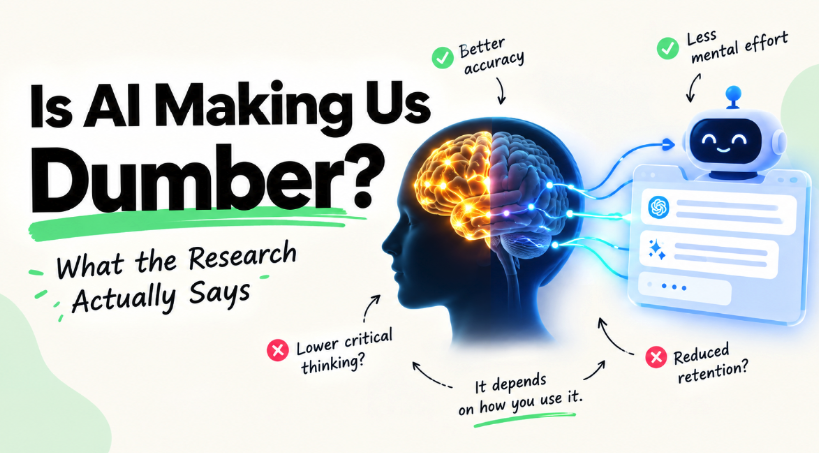
Is AI Making Us Dumber? — What the Research Actually Says
MIT found weaker brain connectivity after AI essay writing. A 2026 study found cognitive decline after just 10 minutes of AI use. Harvard, Stanford, and the University of Melbourne are all studying the same concern. Here is what the research actually says.
By w3codemasters
The question sounds like technophobia. It is not.
The concern about AI and human cognition is coming from neuroscientists, cognitive psychologists, and education researchers at MIT, Harvard, Stanford, and the University of Melbourne — not from people who distrust technology. The research they are producing is not speculative. It is peer-reviewed, empirically grounded, and increasingly consistent in what it finds.
The short answer to whether AI is making us dumber is: it depends entirely on how you use it. The longer answer is that a specific pattern of AI use — one that is becoming the default for millions of people — shows measurable negative effects on memory retention, critical thinking, cognitive persistence, and brain connectivity. And that pattern is spreading faster than the awareness of its consequences.
What the MIT Study Found
The most cited piece of research in this area is a 2025 study from MIT Media Lab involving 54 participants who completed essay writing tasks under three conditions — writing with AI assistance, writing without any assistance, and writing with internet access but no AI.
As reported by Nextgov, participants who exclusively used AI to help write essays showed weaker brain connectivity, lower memory retention, and a fading sense of ownership over their work. EEG measurements showed that participants using AI assistance had lower cognitive engagement signatures during writing.
The most significant finding was what happened next. When participants who had used AI were then asked to perform the same task without AI assistance, they showed measurably reduced performance compared to those who had never used AI help. The MIT Media Lab researchers termed this pattern "cognitive debt" — the cost of offloading cognitive work accumulates in the form of reduced capacity to perform that work independently.
As noted by the Harvard Gazette, the MIT Media Lab study reported that excessive reliance on AI-driven solutions may contribute to cognitive atrophy and the shrinking of critical thinking abilities.
The Ten-Minute Effect
A separate study published in 2026 produced a finding that is harder to dismiss: cognitive effects appeared after just ten minutes of AI use.
As reported by Time Magazine, researchers in the US and UK found that when people spent just ten minutes using AI to help them solve math or reading-comprehension problems, their own unaided performance on the same types of problems diminished. People who received help from AI not only fared worse than a control group who worked without AI assistance — they also gave up on challenging problems more quickly.
The authors described their research as providing causative evidence that relying on an AI for help reduces persistence and impairs unassisted performance. The effect appeared after a single brief session, not after months of heavy use.
Kristy Armitage, a research fellow at the University of Queensland in Australia, was quoted by Time as saying: "It feels as if we're entering a qualitatively different era with AI that seems more concerning than other digital thinking tools."
Cognitive Offloading — The Mechanism Behind the Research
To understand why these effects are occurring, it helps to understand the concept of cognitive offloading — the use of external tools to support reasoning, remembering, and other mental processes.
Cognitive offloading is not new. Writing things down, using a calculator, following a GPS — these are all forms of offloading cognitive work to external systems. The concern about AI is not that offloading happens but that AI offloading is qualitatively different from previous tools in two ways.
First, the range of cognitive tasks AI can handle is dramatically wider than any previous tool. A calculator handles arithmetic. GPS handles spatial navigation. AI handles argument construction, creative synthesis, complex problem-solving, research, writing, coding, and analysis — the full spectrum of higher-order cognitive work that defines intellectual development.
Second, AI makes offloading frictionless. The effort required to use a calculator or look something up in a book created a natural limit on how much offloading occurred. Asking an AI is as easy as thinking out loud.
As noted by the University of Melbourne's Pursuit, Cognitive Load Theory tells us that brains need a certain level of difficulty to process information deeply. If something is too easy — like getting AI to write an essay — the brain does not engage enough to form lasting knowledge. Psychologists call this the productive struggle: working through difficult problems builds resilience, confidence, and deep understanding.
The Concept of AI-Induced Cognitive Atrophy
A 2026 paper published in ScienceDirect introduced the term AICICA — AI-chatbots-induced cognitive atrophy — to describe the potential deterioration of essential cognitive abilities resulting from excessive dependence on AI tools.
As detailed by ScienceDirect, the research identifies AI overreliance as linked to a decline in critical thinking, decision-making capacity, and memory. The mechanism is a feedback loop: AI provides fluent, immediate answers, which reduces the cognitive effort users invest in problems, which reduces the development and maintenance of the skills needed to solve those problems independently.
A mixed-methods study by Gerlich in 2025 of 666 participants across diverse age groups found that heavy AI tool use was associated with decreased critical thinking ability, mediated by cognitive offloading. The study identified what the author terms "cognitive laziness" — a decline in the inclination to engage in deep, reflective thinking — as a consequence of persistent AI reliance.
Kim et al., in a 2026 conceptual review, documented that the fluency with which AI provides solutions creates a feedback loop where users progressively delegate more cognitive work to AI systems, with the long-term consequence of atrophying their own capacities.
The GPS Parallel — And Why It Matters
The strongest historical parallel for what researchers are observing with AI is GPS navigation.
As noted by the University of Melbourne research, studies have found that people who frequently use GPS show poorer spatial memory and a weaker ability to navigate without assistance. People who relied heavily on GPS performed worse on navigation tasks that required independent spatial reasoning. The skill atrophied because it was no longer practiced.
The GPS effect took years to document because the capability being affected — spatial navigation — is not frequently tested in daily life. Most people never noticed their navigation skills declining because GPS was always available to compensate.
The AI parallel is more consequential because the capabilities being offloaded — critical reasoning, argument construction, writing, analysis — are tested constantly in professional and educational contexts. And unlike GPS navigation, these are the capabilities that define what we consider intelligence.
What the Knowledge Worker Research Shows
A survey of 319 knowledge workers found that the more workers tapped AI for help, the less critical thinking they perceived themselves doing. This finding, reported by Prateek Vishwakarma's analysis of the research, is consistent with what the experimental studies found — but it adds a self-perception dimension. Workers using AI heavily were aware of the change in their own thinking, even without being told to look for it.
This self-awareness is important because it suggests the phenomenon is not an artifact of laboratory conditions. It reflects the experience of people using AI in their actual work, noticing something different about how they approach problems.
The Educational Dimension
The implications for education are the most directly urgent. Students who use AI to complete assignments are not just submitting work they did not produce — they are skipping the cognitive process that the assignment was designed to create.
As the Harvard Gazette noted in its analysis, the productive struggle of working through difficult problems is not an obstacle to learning — it is the mechanism of learning. A student who receives an AI-generated essay does not develop the writing ability the assignment was meant to build. They receive a product without developing the process.
The consequences compound over time. A student who outsources three years of writing assignments to AI will arrive at the end of their education with credentials but without the underlying capabilities those credentials are supposed to represent. Whether employers, institutions, and the broader economy will eventually price in this gap is an open question — but the cognitive research suggests the gap is real.
The Counterargument — And Why It Is Partially Right
The counterargument to AI cognitive decline concerns is that tools have always changed what skills humans need. Writing replaced the memorization traditions of oral cultures. Calculators made arithmetic less essential. Word processors replaced penmanship. In each case, the skills displaced were replaced by more valuable ones.
This argument is partially right. Some cognitive offloading to AI is genuinely beneficial. Using AI to handle routine, low-value cognitive tasks — format standardization, basic fact retrieval, template generation — frees cognitive capacity for higher-order work. There is no meaningful cognitive cost to asking AI to reformat a spreadsheet.
The concern is specifically about offloading the cognitive tasks that are not routine — the ones that develop and maintain higher-order reasoning, analytical capability, and creative synthesis. The research does not suggest that all AI use impairs cognition. It suggests that specific patterns of use — particularly using AI to complete tasks that require effortful thinking — produce measurable negative effects.
As Nextgov noted in its reporting on the MIT study, AI tools can absolutely help with efficiency, especially for time-consuming tasks like data entry or summarizing long documents. But how we use those tools matters quite a bit — not just to ensure accuracy, but to maintain cognitive health.
The Honest Answer
The research available as of 2026 does not support the conclusion that AI is uniformly making everyone dumber. It supports a more specific and more actionable conclusion: using AI to do your thinking for you, in the specific contexts where the struggle of thinking is what develops capability, produces measurable cognitive costs.
That is not a reason to avoid AI. It is a reason to understand what kind of AI use serves your long-term cognitive interests and what kind does not.
According to Wikipedia on cognitive load, the effort required to process information is not simply a burden to be eliminated — it is the mechanism through which learning and skill development occur. Tools that reduce the right kind of cognitive effort are beneficial. Tools that eliminate the effortful processing that produces durable understanding do something more complicated.
The question is not whether AI is making us dumber in the abstract. The question is whether your specific pattern of AI use is developing your capabilities or substituting for them. The research suggests that distinction matters more than most people currently appreciate, and that the consequences of getting it wrong accumulate over time in ways that are difficult to reverse.
