
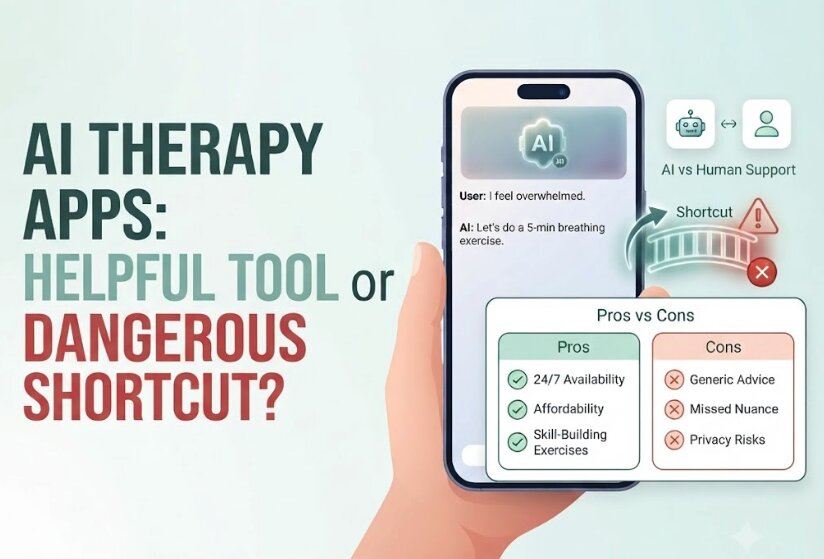
AI Therapy Apps — Helpful Tool or Dangerous Shortcut?
Over 1 million users per week have conversations with ChatGPT about suicide planning. The NHS has deployed a validated AI mental health tool. A Harvard researcher testified before Congress. Here is what the research actually shows about AI therapy apps.
By w3codemasters
On November 18, 2025, a Harvard Medical School researcher testified before Congress about something that had not previously reached that level of formal attention.
John Torous, a physician and digital psychiatry researcher at Harvard, told a subcommittee of the House Committee on Energy and Commerce: "AI tools that were never designed for mental health support are being used by millions of Americans each week. In late October, OpenAI reported that over 1 million users per week have conversations with ChatGPT that include explicit indicators of potential suicide planning."
He also added something less often quoted: "We have to acknowledge that millions of Americans also find some degree of support from AI, and our research has shown that there can be benefit."
That tension — genuine benefit alongside genuine danger — is what makes AI therapy apps one of the most consequential and least understood developments in healthcare right now. The question is not simply whether these tools help or harm. It is who they help, who they harm, under what conditions, and whether the systems being deployed are equipped to tell the difference.
The Scale of What Is Already Happening
The digital mental health market is projected to reach $17.5 billion by 2028. The WHO estimates a global shortfall of 10 million mental health workers. In the United States, the average wait time to see a therapist in many areas exceeds three months. Against that backdrop, the adoption of AI mental health tools is not surprising — it is the predictable response to a supply problem that human systems have not solved.
As reported by Harvard Medicine Magazine, millions of Americans are already using AI for mental health support whether or not that support has been clinically evaluated. A cross-sectional survey found that nearly 48.7 percent of adults with a mental health condition who had used AI tools in the past year had used them for mental health support — not as a designed use case, but as an improvised one.
The gap between the scale of use and the state of the evidence is the central regulatory and clinical challenge of 2026.
What the Research Shows — The Positive Evidence
The most cited evidence in favor of AI therapy tools is a randomized controlled trial published in NEJM AI in 2025 — the New England Journal of Medicine's AI-focused publication.
As reported by Talkspace and confirmed in the original publication, participants using an AI therapy chatbot experienced improvements in symptoms of depression, anxiety, and disordered eating. The findings were statistically significant and comparable in magnitude to guided self-help programs — not to human therapy, but to structured self-help.
A 2025 meta-analysis published in the Lancet Digital Health covering 28 randomized controlled trials found a moderate effect size for AI-delivered interventions versus waitlist controls — a Cohen's d of 0.52, which in clinical terms represents a meaningful but not large therapeutic effect. As reported by AI Magicx, multiple randomized controlled trials have shown that AI-delivered cognitive behavioral therapy can reduce symptoms of mild to moderate depression and anxiety by 20 to 40 percent.
For the specific condition of mild to moderate depression and anxiety, the evidence base is genuinely positive. AI-delivered CBT works for this population — not as well as human therapy, but better than nothing, and better than a months-long waitlist.
The access argument is the strongest case for AI therapy. An AI tool is available at 3am when a human therapist is not. It costs a fraction of a therapy session. It eliminates geographic barriers for people in areas with no local mental health providers. For the 57 percent of people with a mental health condition who currently receive no treatment at all, an AI tool that helps may be better than the human treatment that never arrives.
The NHS Deployment — What Validated Use Looks Like
The National Health Service in the United Kingdom provides the clearest example of what validated AI mental health deployment looks like in practice.
As detailed by AI Magicx, Limbic is the first AI tool approved for direct NHS referral pathways. It conducts initial mental health assessments, provides psychoeducation, and helps route patients to appropriate human care — functioning as an intake and triage tool that extends the reach of the human system rather than replacing it.
The NHS deployment model is instructive because it defines what responsible AI mental health use looks like: clinically validated, integrated with human oversight, used for triage and between-session support rather than as a standalone replacement for therapy, and subject to evaluation frameworks from NICE, the National Institute for Health and Care Excellence.
This is what the positive evidence for AI therapy actually supports — not AI as a replacement for human mental health care, but AI as an extension of access and a bridge to human care for people who would otherwise receive nothing.
The Risks — Where the Evidence Diverges
The evidence that AI therapy tools carry real risks is equally documented, and the risks are not theoretical.
The most serious concern documented in the research literature involves what happens when AI mental health tools interact with users in crisis. As reported by PMC's review of AI in psychotherapy, current safeguards of trigger detection and automatic referrals to mental health hotlines may prove inefficient and lacking. The concern is not that these systems do nothing in crisis situations — most have some form of crisis intervention protocol — but that the protocols are not adequate for the actual range and complexity of crisis presentations.
A Harvard testimony before Congress made this concrete with the OpenAI statistic: 1 million users per week having conversations with ChatGPT that include explicit indicators of potential suicide planning. ChatGPT is not an AI therapy app — it is a general-purpose AI assistant with no clinical design, no crisis protocol, and no clinical oversight. That 1 million users per week are using it in this way is a measure of the gap between available mental health support and what people actually need.
The research literature has documented cases where intense engagement with AI mental health tools contributed to delusional thinking — what a 2026 paper in Nature Mental Health describes as "technological folie à deux." As noted in the AI companions and loneliness research, psychiatric research has documented cases where engagement with AI chatbots contributed to delusional thinking or suicidality in vulnerable individuals.
The Bias and Privacy Problems
Beyond crisis response, two structural problems in AI therapy tools are documented across multiple reviews.
Algorithmic bias is the first. As noted in Social Current's analysis, algorithmic bias is a recurring challenge in AI mental health tools — models trained predominantly on certain demographic groups perform less well for underrepresented populations, which means the tools may be least effective for the people most underserved by the existing mental health system.
Data privacy is the second. Mental health disclosures are among the most sensitive personal data that exists. A 2025 study found that heavy emotional self-disclosure to AI tools was common — users share information about depression, trauma, substance use, and suicidal thinking in ways they might not share even with human therapists, because the perceived absence of judgment lowers inhibition. What happens to that data — who can access it, how it is stored, whether it is used to train future models — varies dramatically across apps and is often not clearly communicated.
The FTC enforcement actions in 2025 against two mental health apps for deceptive advertising reflect regulatory attention to this space. The FDA's Digital Health Center of Excellence is developing guidance for AI-driven mental health tools, expected in late 2026.
The Attachment Problem — When Users Bond With AI Therapy
A concern documented across the psychotherapy research literature involves what happens when users form emotional attachment to AI therapy systems — not a risk unique to bad actors or extreme cases, but a predictable consequence of how these systems are designed.
As noted by PMC's review of AI in psychotherapy, when users view AI systems as trustworthy, emotionally aware, and nonjudgmental, these systems act similarly to parts of the therapeutic alliance — the bond between therapist and client that is itself one of the strongest predictors of therapy outcome. The same attachment mechanisms that make AI therapy effective in the short term create ethical complexities around transference, dependency, and clinical responsibility.
Who is responsible when an AI therapy tool provides harmful advice to an attached user? Who is accountable when the system fails to recognize a deteriorating clinical presentation? These questions do not have clear answers in the current regulatory landscape, and the scale of use has outpaced the development of frameworks for addressing them.
The Youth Dimension
The concerns are most acute for minors. In September 2025, the US Federal Trade Commission opened an inquiry into seven companies' chatbots and their effects on children and teens.
California's SB 243, effective in 2026, requires safety protocols for AI companions and mandates that minors receive recurring reminders that the companion is AI, not human. A rapid review of generative AI in youth mental health apps published in 2025 found that while young people generally rated the apps as having good usability, the evidence base for clinical effectiveness in minors is thin and the risks of harmful interactions are less well characterized than in adults.
As documented by NCBI's review of generative AI in youth mental health, the regulatory and clinical frameworks for AI mental health tools in minors are less developed than those for adults, despite minors being a significant and growing segment of the user base.
The Honest Framework
The question in the title — helpful tool or dangerous shortcut — is not answerable with a single answer because the answer depends on how the tool is being used, by whom, and in what clinical context.
For mild to moderate depression and anxiety in adults who have no other access to mental health support, AI therapy tools with a legitimate evidence base represent a genuine improvement over receiving no support at all. The NEJM AI trial, the Lancet meta-analysis, and the NHS Limbic deployment all support this conclusion.
For people in acute crisis, for people with severe or complex mental health presentations, and for minors without appropriate safeguarding measures, AI therapy tools carry risks that the evidence documents clearly and that current systems are not adequately equipped to manage.
The middle ground — the question of whether people with access to human therapy should use AI tools as a supplement — is where the research is genuinely unsettled. There is evidence for between-session support. There is concern about displacement of human engagement by convenient AI alternatives.
According to Wikipedia on digital therapeutics, regulated digital health tools are subject to clinical validation requirements that distinguish them from general wellness apps. That distinction — between a clinically validated digital therapeutic and an app marketed with mental health language but without clinical validation — is the most important distinction consumers can make when evaluating these tools.
The honest answer is that some AI therapy apps are evidence-based tools that can extend mental health access to people who currently have none. Others are commercial products making clinical claims without clinical validation. The regulatory frameworks to reliably distinguish between them are still being developed. Until they exist, the burden of that distinction falls on users — most of whom have no way to make it.
